Sublimation has a hard limit that every crafter eventually hits: it needs polyester, and it needs the item to be light coloured. That rules out the black cotton T-shirt, which is the single most requested garment there is. Heat transfer vinyl covers that gap, but it is cut vinyl, so a photograph or a design with forty colours is not realistically on the table.
Direct-to-film printing is what sits in that space. It prints a full-colour design onto a film, bonds it with adhesive powder, and presses onto almost any fabric regardless of colour or fibre. This is what the D1 and its companion presses are for.
What DTF does that the other two cannot
- Prints on cotton, blends and polyester without changing method.
- Works on dark garments, because the process lays down white ink beneath the colour.
- Handles photographic and multi-colour artwork with no weeding at all.
- Produces transfers you can make in a batch and press later, rather than one at a time.
That last point is the one that changes how a small operation runs. Transfers can be printed in a quiet hour and stored, so the pressing itself becomes a short, predictable job rather than the bottleneck.
The D1 and its kit options
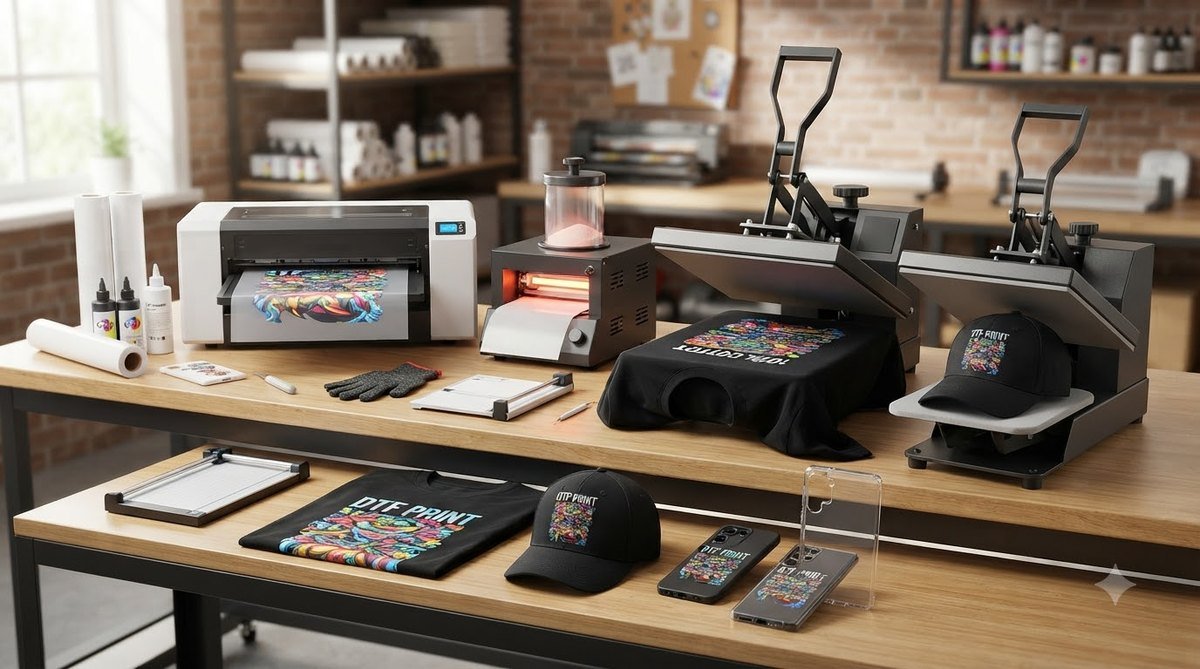
The HTVRONT D1 DTF printer is an A3-format machine running at 1440 DPI with batch printing, and it is sold in more than one configuration. The standard kit is the printer itself. The oven kit adds the curing stage, and the all-in-one kit bundles the fuller setup.
The distinction matters because DTF is a two-stage process. After printing, adhesive powder has to be applied and then cured with heat before the transfer will bond to anything. Skipping that stage is not an option, so the honest question when choosing a kit is whether you already have a way to cure powder or whether you need the oven in the box.
The film is a consumable, and it matters
DTF transfer film is not generic. The coating determines how cleanly the powder adheres and how completely the design releases onto the garment, and a mismatched film is a common cause of transfers that crack or lift after a wash or two.
The transfer film roll sized for the A3 machine is the sensible default, and buying it in a roll rather than sheets suits the batch-printing workflow the printer is built around.
Where the niche presses come in
A flat press covers garments. It does not cover the two product categories that carry the best margins for small studios, which are caps and phone cases.
The A300 Auto Hat Heat Press has a curved platen shaped for the front panel of a cap, so the design sits flat against a surface that is not flat. Caps are a strong seller for clubs, small businesses and events, and they are difficult to produce convincingly any other way.
The H17 Phone Case Heat Press is narrower still in purpose and correspondingly useful: phone cases are small, light to post, and people replace them often. A universal fixture set extends which case shapes it will take, which is worth checking against the models you plan to stock in the phone case accessories range.
How DTF sits next to what you already own
It replaces less than people assume. A DTF setup does not make a vinyl cutter redundant, because single-colour lettering is still faster and cheaper to cut than to print and cure. It does not replace sublimation either, since sublimation on a white polyester mug still gives a finish that sits in the material rather than on it.
What it does is remove the category of job you currently have to refuse. Most small studios end up running all three, choosing per order rather than per machine, and the press on the bench is the one piece of equipment every route shares.
An honest note on scale
A DTF setup is a different order of commitment from a vinyl cutter and a press, in space and in running costs as well as in the machine itself. It needs somewhere ventilated, it needs consumables bought regularly, and it rewards volume.
If you are pressing a handful of garments a month, vinyl and sublimation remain the sensible tools, and there is no shame in that. If you are already turning away full-colour work on cotton, or repeating the same design dozens of times, the equation changes. Look at the DTF and press range against the orders you are actually declining rather than the ones you imagine.
We cover equipment for small makers regularly on flauntchic, so look in before you scale up.
 English